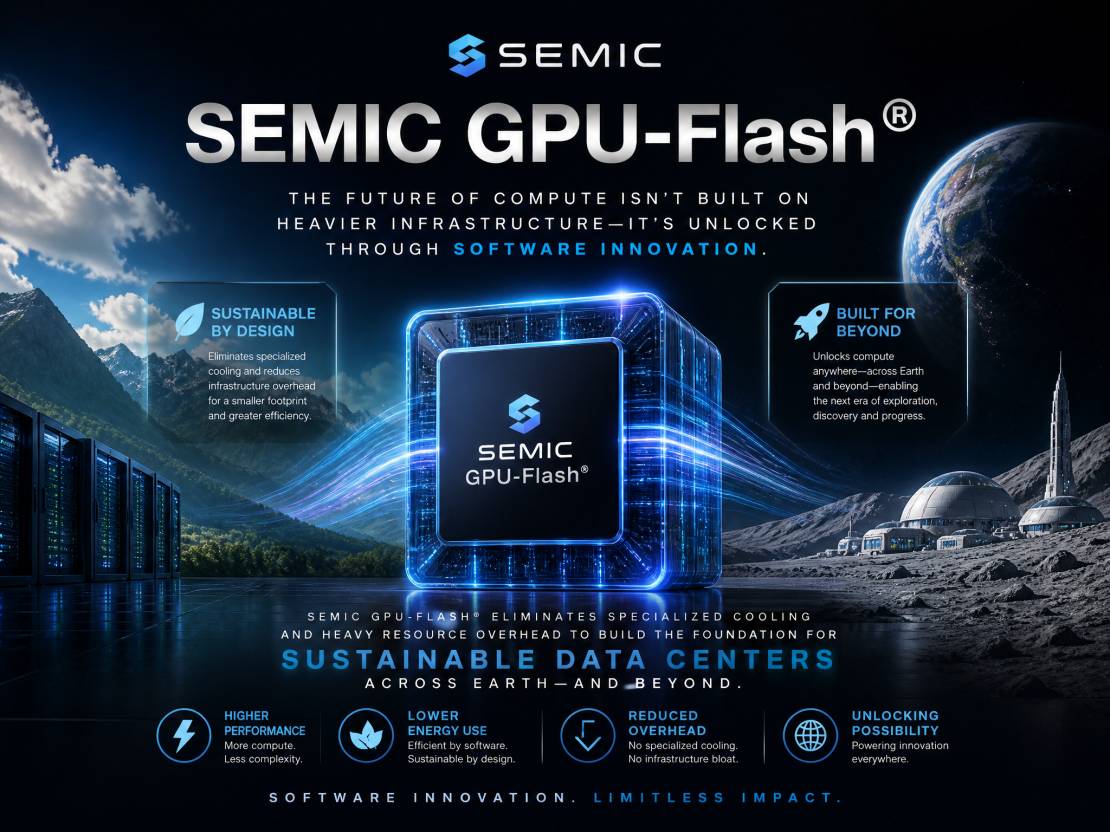
The Green Compute Frontier: Software-Defined GPUs for Terrestrial and Space Infrastructure
A White Paper on SEMIC GPU-Flash® and SEMIC SDGPU® Technology — SEMIC RF, November 2026
Executive Summary
The world is entering an unprecedented era of computational demand. Artificial intelligence, machine learning, scientific research, medical imaging, autonomous systems, financial modelling and high-performance computing are driving an enormous expansion of data-center infrastructure — not only on Earth, but increasingly in orbital and deep-space platforms as well.
At the center of this expansion is the Graphics Processing Unit (GPU). Modern GPU platforms deliver exceptional computational performance, but the infrastructure supporting high-density GPU computing introduces significant challenges: electrical power demand, thermal management, specialized cooling infrastructure, water consumption, hardware procurement costs, and the environmental impact of manufacturing and replacing specialized processors.
SEMIC RF introduces a fundamentally different approach: SEMIC GPU-Flash®, also known as the Software-Defined GPU (SEMIC SDGPU®) — the world's first software-defined GPU. It is an innovative computing architecture designed to deliver GPU-class computational capabilities through a software layer operating over commercially available Central Processing Units (CPUs), rather than depending exclusively on dedicated GPU accelerator chips.
SEMIC GPU-Flash® is designed to work with commercially available, off-the-shelf server hardware, offering a new way to deploy and scale accelerated computing infrastructure — on terrestrial data-center floors and aboard space platforms where mass, power and cooling budgets are tightly constrained.
- Reduced dependence on specialized GPU hardware
- Software-based upgrades instead of mandatory chip replacement
- Dynamic reconfiguration for different workloads
- Simplified cooling infrastructure with no dedicated GPU cooling loop
- Potential water savings by avoiding water-dependent GPU cooling
- Hardware flexibility across commercially available server configurations
- Better utilization of existing computing resources
- Reduced lifecycle environmental impact
The Changing Landscape of Data Centers
Data centers have become essential infrastructure for the modern world. Every major industry increasingly depends on computational power, from healthcare and manufacturing to banking, telecommunications, energy, transportation and scientific research. The rapid adoption of artificial intelligence has accelerated the need for computing infrastructure capable of processing enormous quantities of data.
Traditionally, this demand has been addressed by installing specialized GPU processors in increasingly powerful servers and interconnected computing racks. While this approach has enabled remarkable advances, it also creates infrastructure challenges that must be rethought — not simply by building faster processors, but by reconsidering how computing performance is delivered and how supporting infrastructure is designed.
- High-density processor installations
- Significant electrical power requirements
- Advanced thermal management and air-conditioning
- Liquid-cooling and coolant distribution systems
- Water consumption in water-dependent cooling facilities
- Specialized power distribution
- Expensive hardware replacement cycles
- Electronic waste from obsolete computing equipment
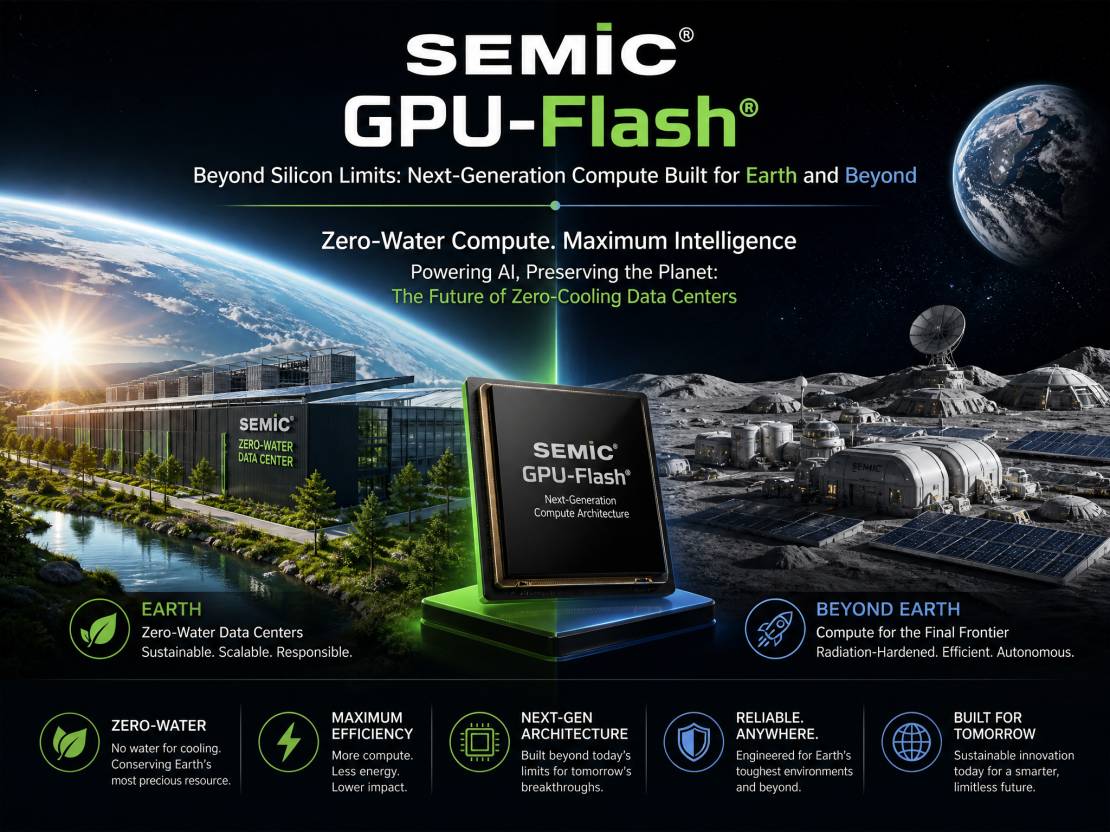
Introducing SEMIC GPU-Flash® (SEMIC SDGPU®)
SEMIC GPU-Flash® represents SEMIC RF's approach to software-defined accelerated computing. It is designed to operate as a software acceleration layer over a CPU, transforming the way computational resources are organized, allocated and utilized.
In conventional systems, a GPU is a separate physical processor with specialized computational units and dedicated memory architecture. With SEMIC SDGPU®, SEMIC RF implements GPU-class computational functions through a software-based architecture that executes on the underlying CPU platform.
The Fundamental Concept
Instead of requiring a specialized GPU chip for every accelerated computing requirement, SEMIC GPU-Flash® uses an intelligent software architecture to organize and execute computational workloads using available CPU resources. This provides an alternative architectural model for organizations that want accelerated computing capability without necessarily investing in dedicated GPU hardware.
- Parallel computational execution
- Workload distribution and resource allocation
- Data processing and movement
- Memory utilization optimization
- Application-specific tuning
- Dynamic configuration
- Software-based performance improvements
A New Computing Model Compared
The table below contrasts conventional dedicated GPU architecture with the SEMIC GPU-Flash® approach. It describes architectural objectives only; actual performance, compatibility and operating costs must be established through independently reproducible testing, workload by workload.
Conventional GPU:
- Dedicated physical GPU processor
- Specialized GPU hardware required
- Hardware-specific capabilities
- Hardware replacement for upgrades
- Dedicated GPU thermal management
- Specialized accelerator procurement
- Hardware-dependent deployment
SEMIC GPU-Flash®:
- Software-defined acceleration layer
- Utilizes CPU-based hardware
- Software-configurable capabilities
- Software upgrades for supported improvements
- No dedicated GPU cooling system
- Suitable off-the-shelf server hardware
- Software-oriented deployment
The Environmental Advantage: Computing Without Dedicated GPU Cooling
One of the most important motivations behind SEMIC GPU-Flash® is reducing the environmental and infrastructure burden associated with dedicated GPU accelerators. High-performance computing generates heat that must be managed to maintain reliability and stability. In certain modern GPU installations, specialized liquid-cooling infrastructure, coolant distribution units and associated thermal-management equipment are required.
Because SEMIC SDGPU® does not require a separate physical GPU accelerator, it can potentially eliminate dedicated GPU coolant circulation, GPU-specific liquid-cooling distribution, cooling manifolds, and GPU accelerator cooling maintenance. The underlying CPU server will still generate heat and require appropriate thermal management, but the dedicated GPU cooling layer is removed from the equation.
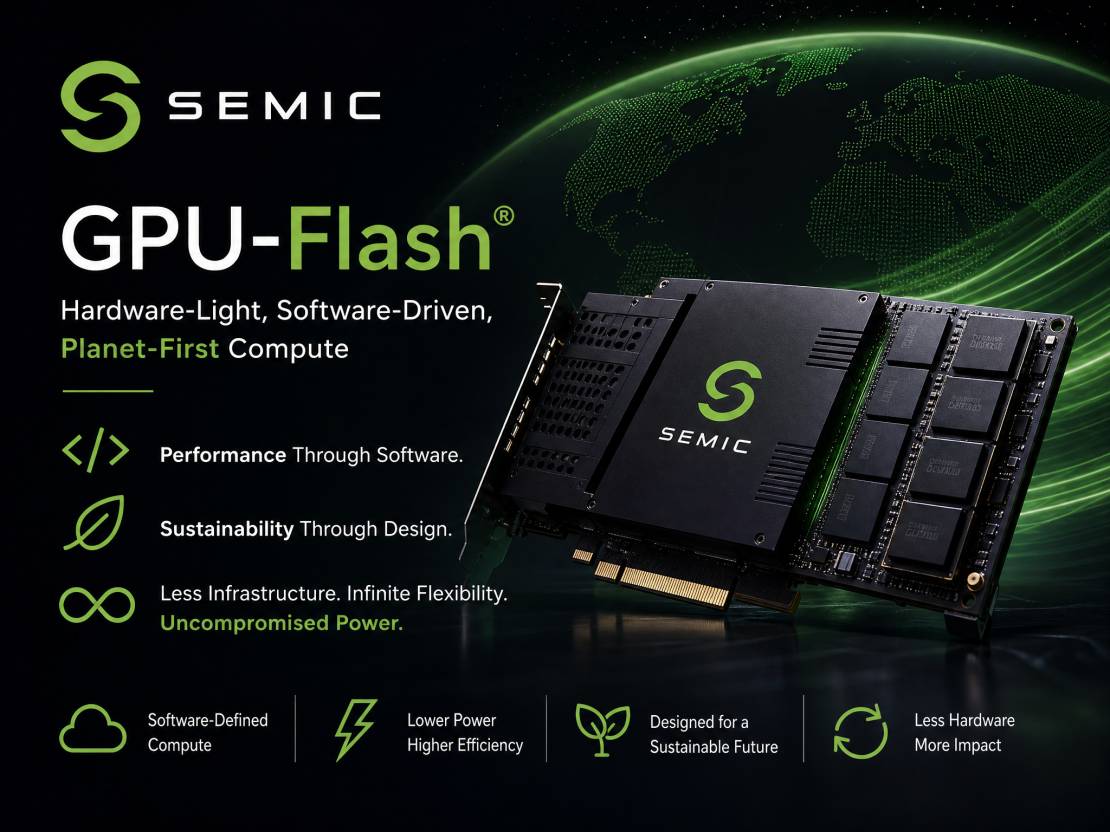
Water Conservation and Footprint Reduction
Water is an increasingly important consideration in data-center planning, and an even more critical constraint for off-world platforms where water and coolant mass must be launched from Earth. SEMIC GPU-Flash® creates an opportunity to design facilities — terrestrial and orbital alike — that avoid water-dependent GPU cooling systems.
Removing dedicated GPU hardware and associated cooling equipment also simplifies overall server architecture, which is especially valuable where every kilogram and every watt must be justified, such as in satellite and spacecraft payloads.
- Reduced direct water consumption for GPU cooling
- Reduced dependence on water-intensive thermal infrastructure
- Lower coolant-system maintenance requirements
- Greater flexibility in selecting data-center locations, including water-stressed regions
- Fewer specialized hardware components and simplified maintenance
- Potential mass and power savings relevant to space-based deployments
Software Upgrades Instead of Hardware Replacement
Traditional GPU hardware is manufactured around a particular physical architecture. Although drivers, firmware and software frameworks can be updated, the fundamental processing architecture remains tied to the chip. SEMIC RF approaches this differently: SEMIC GPU-Flash® is designed to evolve through software, enabling organizations to improve computing capability without automatically replacing underlying processor hardware.
Different industries have different computational requirements. A medical imaging center may need high-speed image reconstruction, while an AI research organization may require neural-network inference and large-scale mathematical processing. SEMIC SDGPU® is designed to support software-level reconfiguration so a common computing platform can be adapted across workloads.
- New computational algorithms introduced via software
- Improved parallel processing and workload distribution methods
- Support for new application requirements and memory management
- Reconfigurable processing resources
- New AI and scientific computing capabilities over time
- Adaptable to AI, machine learning, medical imaging, scientific computing, signal processing, data analytics, engineering simulation and enterprise computing
Working With Off-the-Shelf Hardware
SEMIC RF's approach reduces dependence on proprietary accelerator hardware. SEMIC GPU-Flash® is designed to work with suitable commercially available CPU-based server platforms, offering a different procurement and deployment model for data-center operators. Instead of building infrastructure around a particular specialized GPU platform, organizations can evaluate commercially available servers based on processing capacity, memory, storage, networking and power characteristics.
This hardware flexibility can lower barriers to entering accelerated computing, reduce dependence on specialist GPU supply chains, ease infrastructure standardization, and extend the useful life of existing server assets — advantages that are particularly relevant to enterprises, universities, research institutions, healthcare organizations, emerging data-center operators, and space-system integrators seeking flight-qualified compute platforms.
- Commercial x86 server processors
- Compatible ARM-based processors
- Standard server motherboards and commercial DDR memory
- NVMe storage and standard networking equipment
- Conventional server racks and existing enterprise infrastructure
- Actual compatibility determined by SEMIC RF's supported hardware matrix
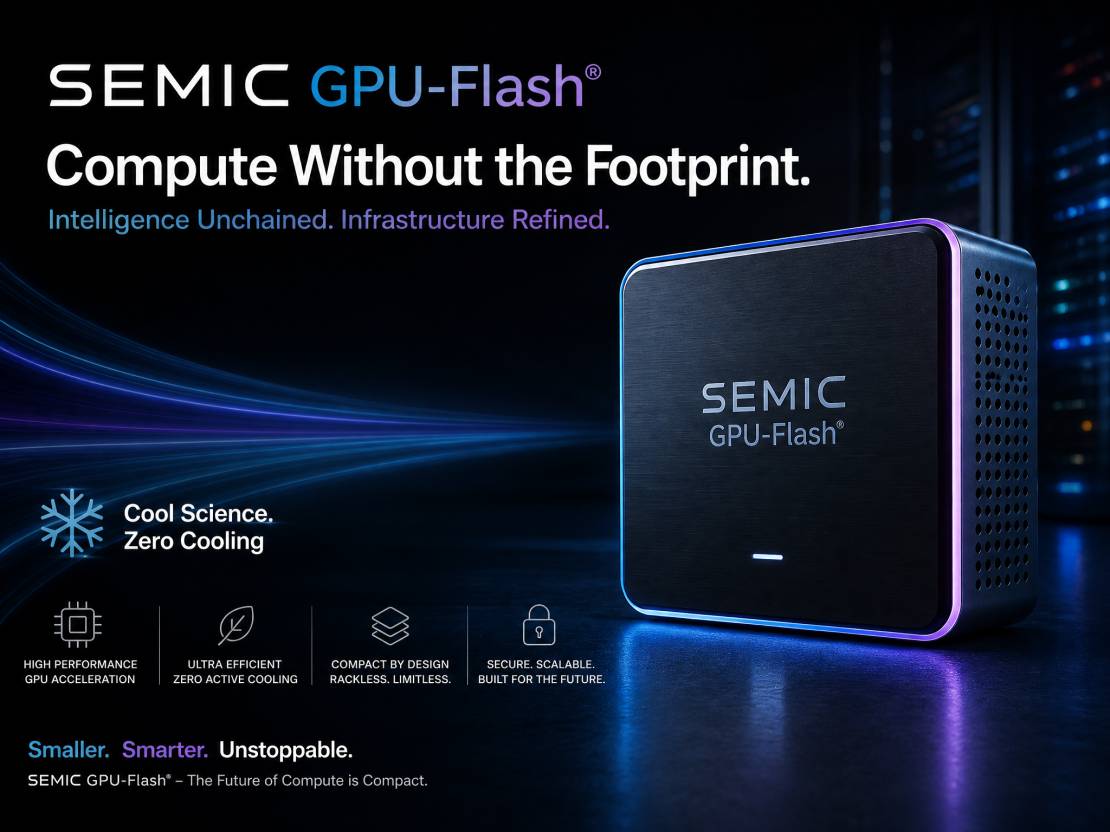
The Green Data Center Revolution
SEMIC RF believes the next generation of data centers should be evaluated not only by processing speed but by environmental impact across the entire infrastructure lifecycle — from raw material extraction and semiconductor manufacturing to electricity consumption, cooling, water use, maintenance and electronic waste.
SEMIC GPU-Flash® offers an opportunity to address several of these challenges through software-defined computing: reducing demand for specialized accelerator manufacturing, extending the useful life of compatible CPU server infrastructure through software upgrades, and eliminating dedicated GPU cooling systems and their associated water requirements.
The key measurement should be energy consumed per useful computational task, rather than processor power alone — and these environmental benefits should ultimately be demonstrated through independently verified measurements covering electricity, water, cooling, hardware manufacturing and lifecycle impacts. SEMIC RF's objective is to make these benefits measurable, transparent and repeatable.
Applications Across Industries
The potential applications of SEMIC GPU-Flash® and SEMIC SDGPU® extend across multiple sectors. Suitability and performance in each case will depend on workload-specific testing and software support.
- Artificial Intelligence and Machine Learning: inference, neural-network processing, computer vision, intelligent automation
- Healthcare and Medical Imaging: MRI, CT, X-ray, ultrasound processing, digital pathology, AI-assisted diagnostics
- Scientific and Engineering Computing: mathematical modelling, numerical simulations, spectral analysis, research computing
- Enterprise and Cloud Computing: AI-enabled applications, business analytics, large-scale data processing, virtualized services
- Telecommunications and Signal Processing: digital signal processing, radar and sensor data analysis, spectrum analysis
- Space and Off-World Systems: onboard satellite data processing, radiation-tolerant compute without dedicated GPU thermal loops, autonomous spacecraft systems
The Economics of Software-Defined Computing
The economics of a data center are determined by more than the purchase price of its processors. Operators must consider hardware acquisition, server infrastructure, electricity, cooling, water, maintenance, software licensing, hardware replacement, space utilization and operational personnel. SEMIC GPU-Flash® introduces a different cost structure by reducing or eliminating GPU procurement for supported workloads, lowering specialized cooling and coolant-management requirements, and enabling capability improvements through software rather than hardware upgrades.
The actual financial benefit will depend on the cost of CPU resources, SEMIC SDGPU® licensing, electricity, performance achieved and the workload being deployed.
- Reduced or eliminated GPU procurement for supported workloads
- Lower specialized cooling infrastructure requirements
- No dedicated GPU coolant management
- Software-based capability improvements instead of hardware upgrades
- Greater choice of compatible commercial servers
- Potentially longer use of compatible equipment and existing infrastructure
Vision: Planet-Friendly Data Centers — Terrestrial and Space
SEMIC RF is working towards a future in which computational performance is not necessarily dependent on increasingly specialized physical accelerators. SEMIC GPU-Flash® represents a new approach to the design and deployment of accelerated computing, applicable equally to Earth-based data centers and the next generation of orbital and deep-space computing platforms, where mass, power and cooling constraints make dedicated GPU hardware especially costly.
SEMIC RF believes that software innovation can become a major contributor to sustainable digital infrastructure, both on our planet and beyond it. The future of computing should not be measured only by how many calculations a processor can perform, but by how intelligently, economically and responsibly those calculations are delivered.
- Leverage commercial off-the-shelf (COTS) hardware
- Decrease reliance on dedicated GPU processors
- Reduce specialized cooling infrastructure and avoid dedicated GPU coolant systems
- Minimize water-dependent cooling requirements
- Evolve through software upgrades and adapt dynamically to different workloads
- Reduce hardware replacement requirements and improve resource utilization
- Measure and minimize environmental impact across Earth and space deployments
Conclusion: A New Direction for the Computing Industry
The demand for computing power will continue to increase as artificial intelligence and digital technologies become integral to everyday life. The traditional approach of addressing every new computing requirement through specialized hardware creates opportunities for innovation in alternative architectures. SEMIC GPU-Flash®, the Software-Defined GPU (SEMIC SDGPU®), introduces such an alternative.
By placing software-defined acceleration over commercially available CPUs, SEMIC RF aims to change the economics, flexibility and infrastructure requirements of accelerated computing. The ability to upgrade through software, reconfigure processing resources and reduce dependence on dedicated GPU hardware creates an opportunity to develop a more adaptable generation of data centers — on Earth and in space.
A computing architecture that can reduce specialized cooling requirements, water dependence, hardware replacement and lifecycle impacts could contribute meaningfully to more sustainable digital infrastructure. SEMIC RF's ambition is not simply to introduce another computing product, but to advance a different philosophy of computing: performance through software, flexibility through innovation, sustainability through intelligent architecture.
SEMIC RF — SEMIC GPU-Flash®: Powering Intelligence. Reducing Infrastructure. Protecting Our Planet. SEMIC RF is building the foundation for a new generation of planet-friendly data centers, terrestrial and beyond.