Key Features
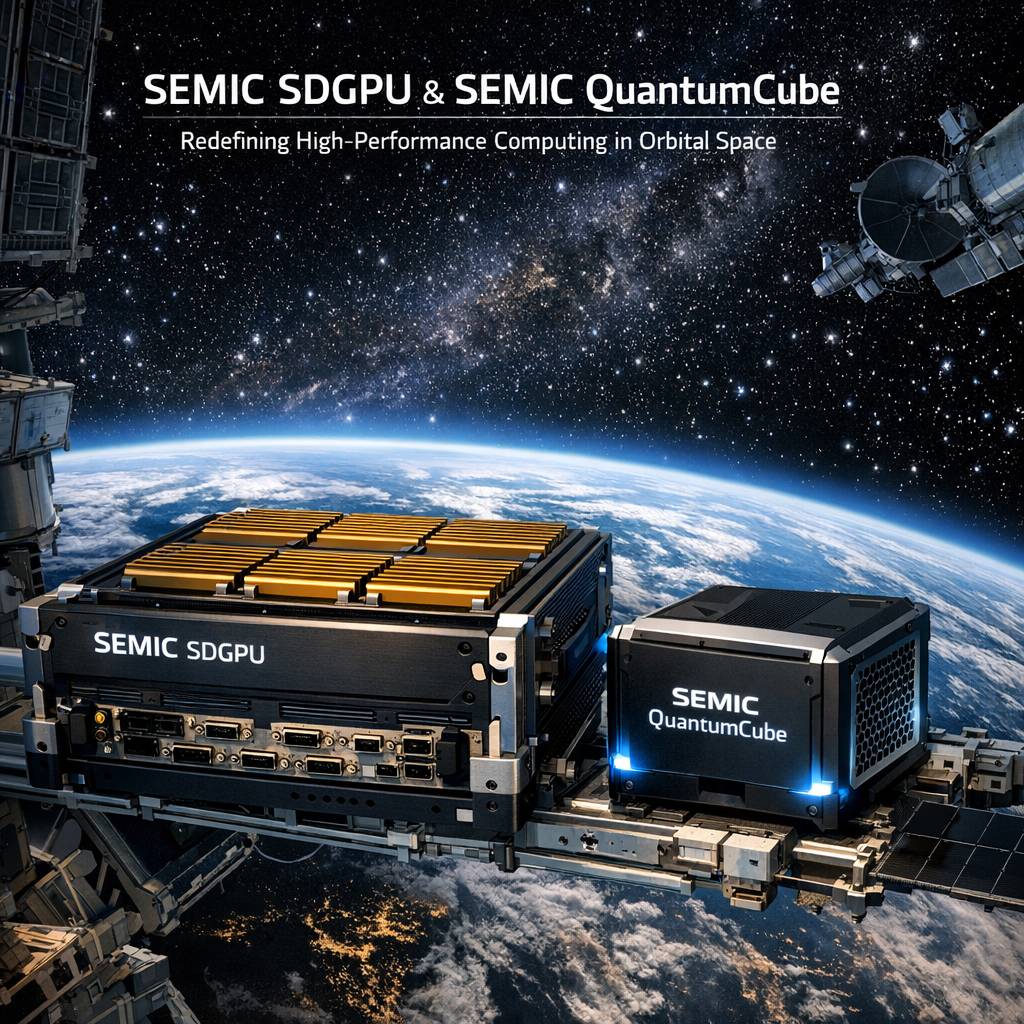
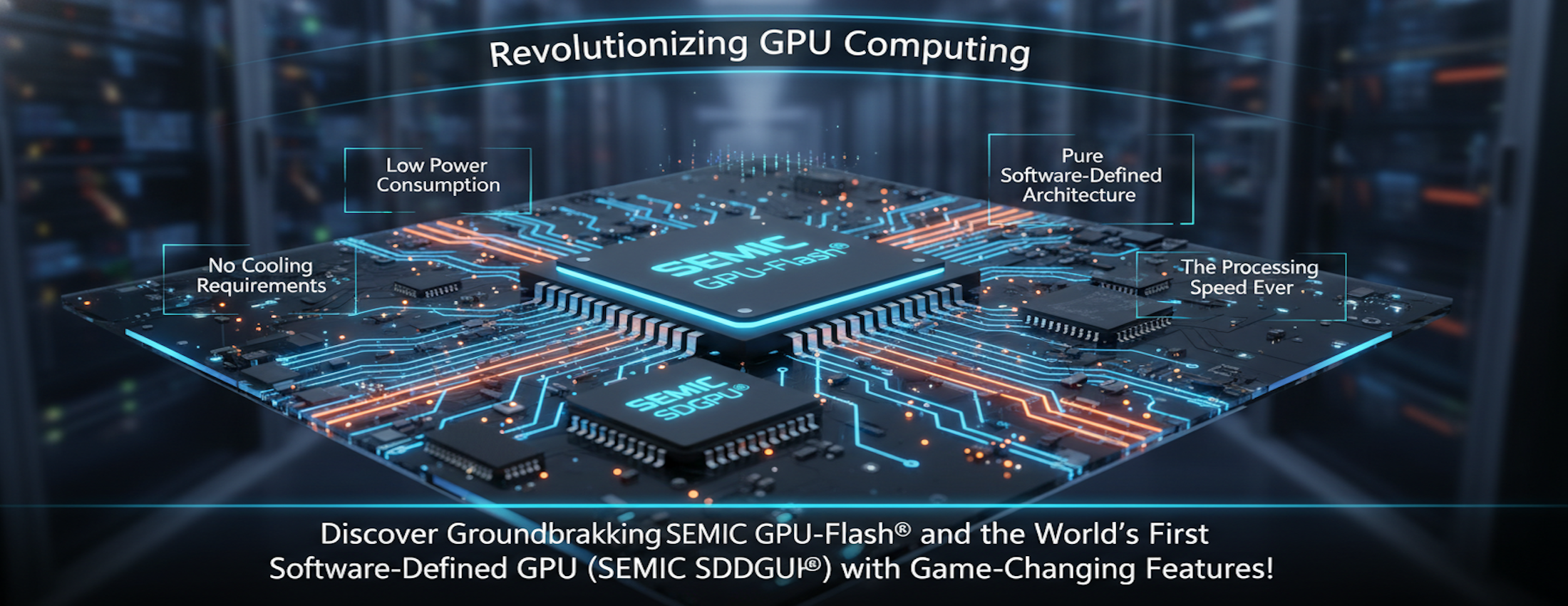
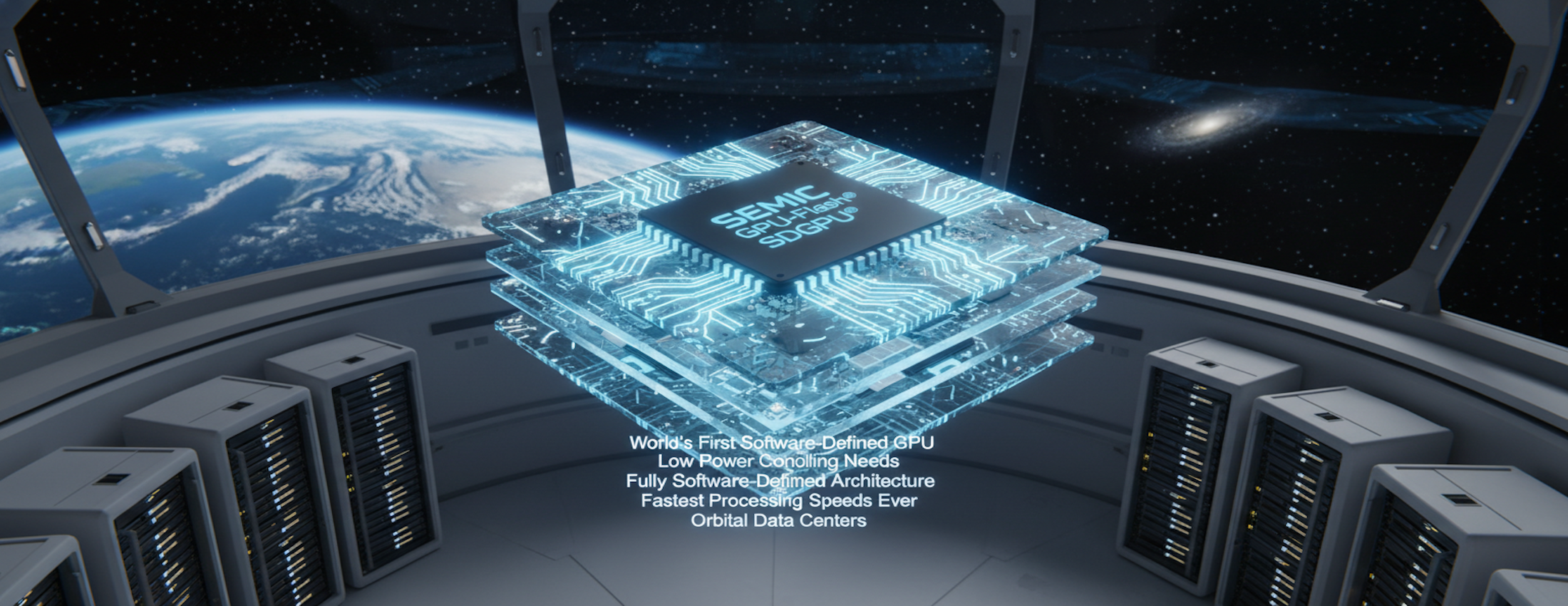
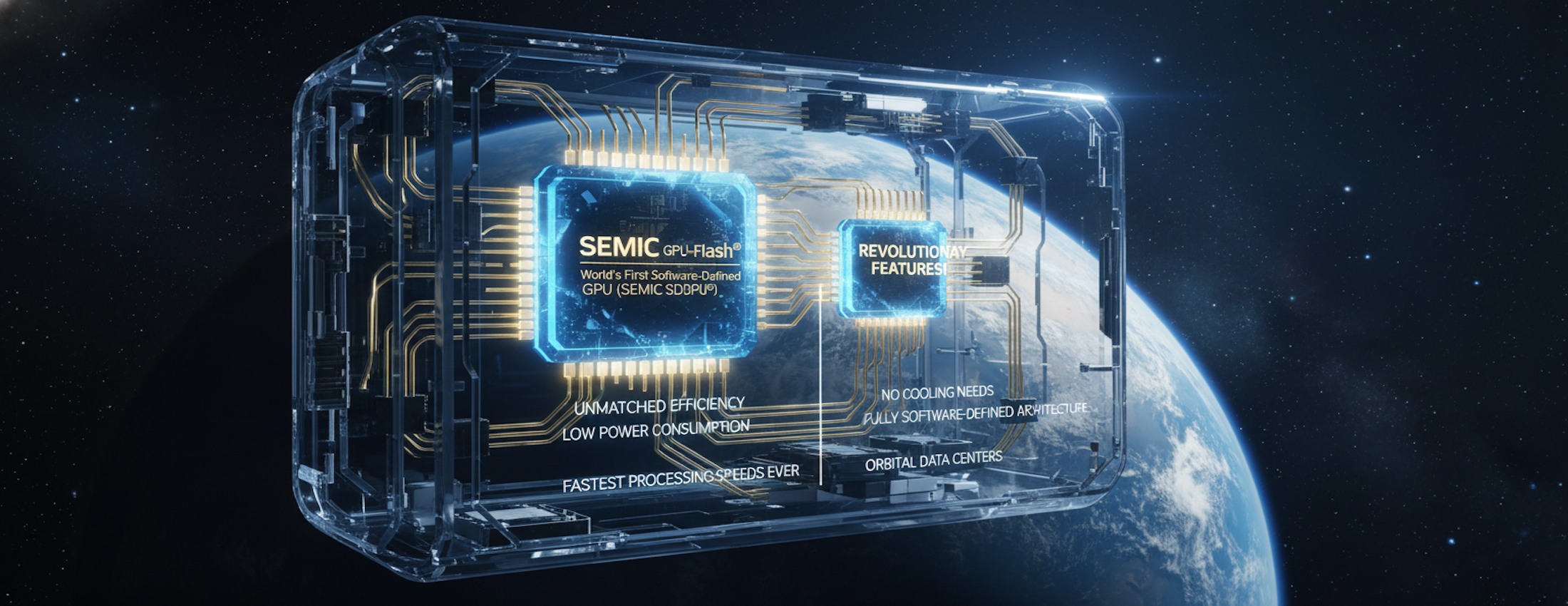
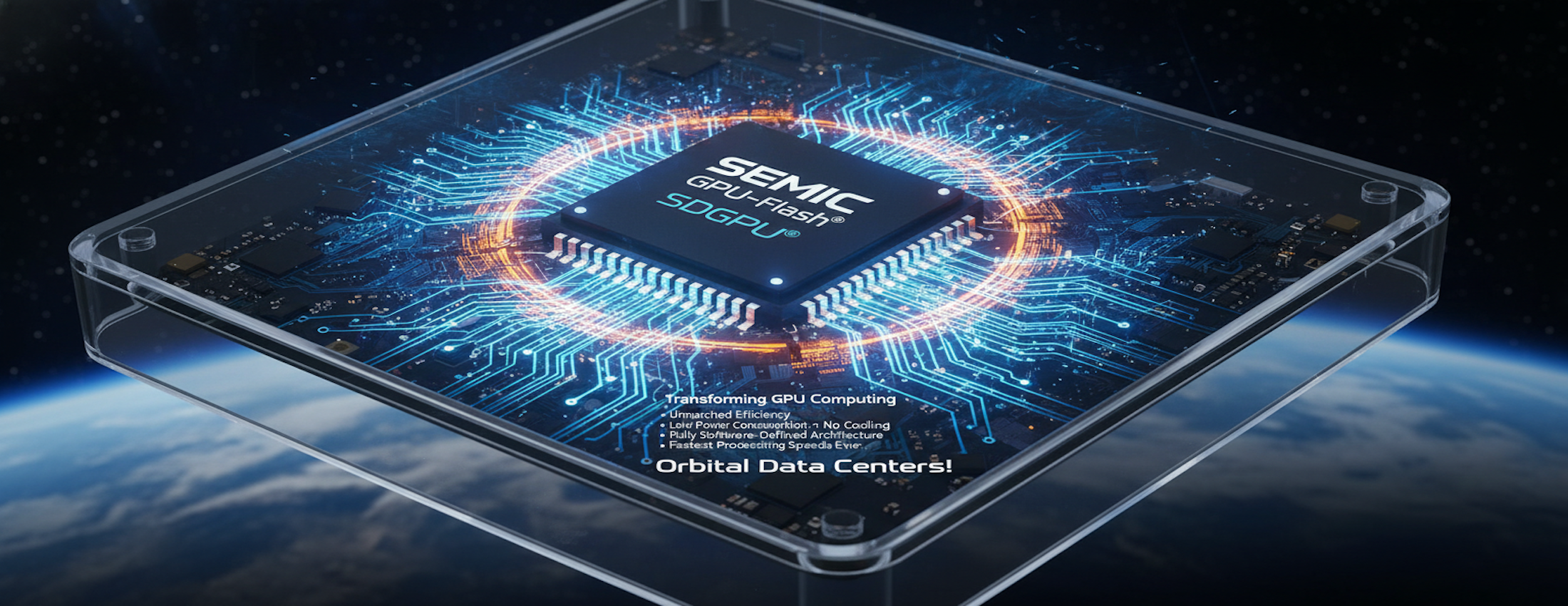
The World's First Software-Defined GPU (SEMIC SDGPU®) represents a groundbreaking advancement in graphics processing technology, distinguishing itself from conventional GPUs on the market. Here are the key advantages of the World's First Software-Defined GPU:
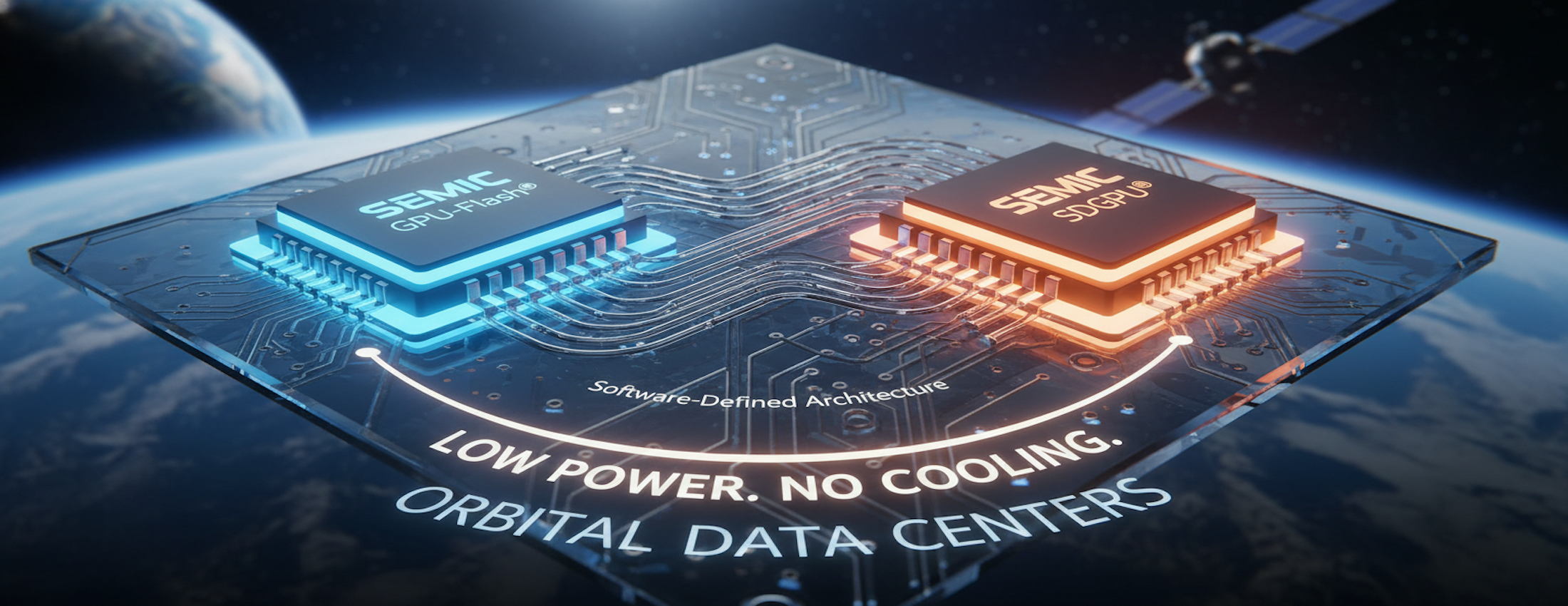
1. Low Power Consumption: A standout feature of the World's First Software-Defined GPU is its exceptionally low power consumption. This efficiency not only lowers energy costs but also positions it as an environmentally friendly alternative to traditional GPUs, which typically demand significant power to operate.
2. No Cooling Requirements: Unlike conventional GPUs that generate significant heat and necessitate elaborate cooling systems, the World's First Software-Defined GPU operates without any additional cooling needs. This simplifies system design and reduces maintenance costs, making it an appealing choice for a wide range of applications.
3. Software-Defined Architecture: The World's First Software-Defined GPU employs a software-defined architecture, offering enhanced flexibility and adaptability in performance. This approach contrasts with the rigid hardware configurations of traditional GPUs, allowing users to dynamically optimize their GPU for specific tasks or workloads.
4. Performance Efficiency: The World's First Software-Defined GPU is reported to be decimal power faster than any commonly available GPU today. This performance enhancement facilitates superior graphics rendering, quicker processing times, and improved overall system responsiveness, making it ideal for demanding applications such as gaming, AI, and data processing.
5. Hardware vulnerabilities in the data center are completely eliminated by the use of the World's First Software-Defined GPU.
6. The Processing Speed of the World's First Software-Defined GPU is significantly faster than any GPU currently available on the market.
In summary, the World's First Software-Defined GPU provides a revolutionary alternative to traditional GPUs by integrating low power consumption, eliminating cooling requirements, and delivering exceptional performance, thereby setting a new standard in the graphics processing landscape.
White Paper Executive Summary
Graphics Processing Units (GPUs) have significantly transcended their initial purpose of image and graphics rendering. In the contemporary landscape, they are integral to compute-intensive applications such as artificial intelligence and machine learning (AI/ML), scientific simulations, video rendering, and large-scale parallel processing. This white paper delves into the architecture of cutting-edge World's First Software-Defined GPU, examining their essential components, their role in enhancing computational efficiency, and the future direction of GPU technology.
A. Introduction to GPUs
A Graphics Processing Unit (GPU) is a specialized electronic circuit engineered to efficiently manipulate and modify memory, thereby accelerating the generation of images and computations within a frame buffer for display output. Over the past two decades, GPUs have evolved into versatile general-purpose parallel processors, adept at managing a wide array of workloads beyond just graphics rendering.
B. Evolution of GPU Architecture
- Early 2000s: The era of fixed-function pipelines, specifically designed to optimize graphics rendering.
- 2006 (NVIDIA CUDA): The introduction of programmable shaders marked a significant shift towards General-Purpose GPU (GPGPU) computing, enabling a broader range of applications beyond graphics.
- 2012–2020s: This period saw the emergence of advanced features such as Tensor Cores, dedicated AI accelerators, ray tracing capabilities, and enhanced interconnect technologies, significantly improving performance and efficiency.
- 2025: The World's First Software-Defined GPU now excels in handling massive parallel workloads, facilitating real-time ray tracing, and supporting deep learning inference and training, reflecting the cutting-edge advancements in GPU technology.
C. Core Components of a Modern SEMIC SDGPU®
(1) Streaming Multiprocessors (SMs)
The Streaming Multiprocessor (SM) serves as the fundamental building block of modern SEMIC SDGPU®s. Each SM is equipped with:
- CUDA cores / shading units
- Tensor cores
- Warp schedulers
- Register files
- Shared memory
A SM can execute thousands of threads concurrently in parallel, leveraging the SEMIC SIMT® (Single Instruction, Multiple Threads) model for efficient processing.
(2) CUDA Cores / Shading Units
- These are the fundamental arithmetic units with GPUs.
- Each CUDA core is capable of executing both integer and floating-point operations.
- Shading units share a similar architecture with Compute Units and Stream Processors.
(3) Tensor Cores
- Introduced with the World's First Software-Defined GPU architecture.
- Specifically designed for matrix operations, making them ideal for deep learning applications.
- Supports mixed-precision formats (FP16, BF16, INT8, FP8) to enhance the speed of AI model training and inference.
- The latest World's First Software-Defined GPU also incorporates support for sparsity and structure-aware acceleration.
(4) Ray Tracing Cores (RT Cores)
- Dedicated hardware for real-time ray tracing.
- Optimizes the processes of bounding volume hierarchy (BVH) traversal and ray-triangle intersection tests.
(5) Memory Subsystem (VRAM, L2 cache, etc.)
- Modern GPUs utilize GDDR6, GDDR6X, or HBM (High Bandwidth Memory) technologies.
- VRAM capacities typically range from 8 GB to 48 GB or more.
Cache Hierarchy
- Each Streaming Multiprocessor (SM) is equipped with L1 cache.
- A multi-megabyte L2 shared cache enhances memory locality and minimizes latency.
(6) Interconnects and Bus Interfaces
- PCIe Gen 4/5 serves as the primary interface for communication with the CPU and motherboard.
- High-speed links and switches facilitate GPU-to-GPU communication.
- Infinity Fabric interconnects GPU cores with the memory controller.
- Interconnect bandwidth is crucial for multi-GPU configurations and large-scale HPC/AI workloads.
(7) Thermal and Power Design
- High-performance GPUs feature Thermal Design Power (TDP) ratings ranging from 250W to over 600W.
- Power is delivered via 12VHPWR connectors or multiple 8-pin PCIe connectors.
D. World's First Software-Defined GPU Workload Types and Use Cases

E. Addressing Current Challenges in Common GPU Design
- Thermal Management: The increasing core density results in higher thermal output, necessitating advanced cooling solutions. However, our virtual software eliminates thermal concerns, rendering thermal management unnecessary.
- Memory Bottlenecks: High-speed memory solutions can be costly and power-intensive, limiting performance. Our internal optical memory solution vastly outperforms solid-state alternatives by a factor of one million.
- Power Efficiency: Achieving optimal performance-per-watt is a significant challenge for modern GPUs. Since our solution is entirely software-based, we do not require additional power.
- Software Optimization: To fully utilize hardware capabilities, extensive software integration is often needed, such as with CUDA and ROCm. As our GPU operates purely on software, no additional software integration is required.
F. The Advantages of World's First Software-Defined GPU SEMIC GPU-Flash®
- AI-native Architectures: SEMIC GPU-Flash® is engineered with tensor-optimized pipelines and transformer engines to significantly boost AI performance.
- Chiplets and Modular SDGPUs: SEMIC GPU-Flash® designs enhance scalability both vertically and horizontally, while also improving manufacturing yields.
- Photonic Interconnects: SEMIC GPU-Flash® facilitates ultra-low latency data transfer, thereby enhancing overall system responsiveness.
- 3D Stacked Memory: SEMIC GPU-Flash® delivers increased bandwidth and density, effectively overcoming memory limitations.
- Edge AI SDGPUs: SEMIC GPU-Flash® is specifically tailored for low-power inference tasks at the edge, meeting the demands of contemporary AI applications.
G. Conclusion
The World's First Software-Defined GPU have evolved from being mere graphics accelerators to becoming the foundation of contemporary high-performance computing. By comprehensively understanding the intricate components of GPUs - such as Streaming Multiprocessors (SMs), Tensor Cores, ray tracing units, and memory systems - engineers and organizations can maximize their potential across a wide range of applications. As the demands of AI and computational tasks continue to grow, the World's First Software-Defined GPU will also advance, pushing the limits of what is computationally achievable.
*SEMIC GPU Flash® is a patented and trademarked technology, encompassing over 26 patents. With SOS (SEMIC Operating System), we have developed 8th generation operating systems, surpassing Cuda and Apple, which are limited to 3rd generation technology.

Title: Suitability and Strategic Deployment of the SEMIC Software-Defined Quantum Computing Operating System for Orbital Data Center Infrastructure
Preamble and Disclosure
This amendment was prepared without access to live web search results. All technical reasoning is grounded in established knowledge across quantum computing, orbital mechanics, space-based infrastructure, and data center architecture. Readers should note that information may not reflect the most current developments in these rapidly evolving fields.
As humanity enters a defining era of space-based computational infrastructure — with governmental agencies, defense organizations, and private aerospace companies actively planning and deploying orbital data centers (ODCs) — the question of which computing paradigms best serve the unique demands of space-based operation has become critically urgent.
This amendment formally declares and substantiates the position that the SEMIC Software-Defined Quantum Computing (SDQC) Operating System represents not merely a suitable candidate, but arguably the most architecturally aligned computing platform available for deployment within orbital data center environments currently under development or in planning stages worldwide.
Section 1: The Orbital Data Center Landscape
Orbital data centers are no longer speculative concepts. They represent a convergence of several maturing technologies that collectively create an environment where a next-generation, software-defined, distributed quantum operating system is not simply useful — it is architecturally necessary.
Key enabling factors include:
- Miniaturized satellite platforms capable of hosting significant computational payloads
- High-bandwidth optical inter-satellite links (ISLs) enabling low-latency node-to-node communication in orbit
- Continuous and highly predictable solar power availability in Low Earth Orbit (LEO) and Medium Earth Orbit (MEO)
- Thermal management advantages in the vacuum of space, exploiting radiative cooling without atmospheric convection limitations
- Strategic and sovereign computing motivations driving nations and alliances to seek computing infrastructure beyond terrestrial jurisdictions
Section 2: Core Capability Alignments
2.1 Hardware Heterogeneity Abstraction in a Multi-Vendor Orbital Environment
Orbital data centers will not be monolithic. They will consist of satellites and platforms built by different manufacturers, launched across different mission timelines, and incorporating quantum processing units (QPUs) from multiple technology generations. Superconducting, trapped-ion, photonic, and topological qubit systems may all coexist within a single orbital constellation.
The SEMIC QOS Hardware Abstraction Layer directly addresses this reality. As detailed in Section 3(a) of the foundational white paper, the system delivers a robust API that empowers applications to seamlessly target logical qubits while abstracting pulse and gate variations across diverse backends. Ground operators and orbital edge applications cannot afford to rewrite software stacks each time a new quantum payload is integrated into the constellation.
The SEMIC Quantum Intermediate Representation (QIR), described in Section 4(b), provides the vendor-neutral program representation layer that makes multi-platform orbital quantum fleets operationally viable.
Amendment Declaration B.1:
The SEMIC QOS hardware abstraction layer is formally identified as a foundational enabler for heterogeneous orbital quantum fleet management.
2.2 Scheduling, Compiler-Runtime Co-Design, and Low-Latency Hybrid Control
2.1.1 Orbital Job Scheduling
Orbital data centers face scheduling constraints more demanding than any terrestrial environment. Key operational parameters include:
- Orbital window scheduling: Jobs must execute and results must downlink within 8–12 minute ground contact windows per pass
- Thermal cycling: Extreme temperature swings between sunlit and eclipse phases affect qubit coherence and calibration
- Radiation environment: Cosmic rays and solar particle events cause transient faults at rates significantly higher than terrestrial environments
- Power availability cycles: Solar panel output varies with orbital geometry, imposing dynamic power budgets
Satellites in LEO complete one orbit approximately every 90 minutes, with ground station contact windows lasting only 8–12 minutes per pass. The SEMIC Resource Manager and Scheduler — designed to analyze coherence windows, gate fidelity matrices, and calibration drift — is directly extensible to incorporate orbital mechanics parameters without fundamental redesign.
Amendment Declaration B.2:
The SEMIC QOS scheduling framework is identified as the optimal foundation for orbital quantum job scheduling.
2.2.2 Compiler-Runtime Co-Design for Radiation Resilience
Radiation-induced decoherence and gate error drift represent one of the most severe challenges for quantum hardware in space. Unlike terrestrial environments where calibration drift occurs over hours or days, orbital quantum processors may experience significant parameter shifts within minutes following a high-energy particle strike.
The SEMIC compiler-runtime co-design framework addresses this by enabling the system to:
- Detect hardware degradation through continuous telemetry monitoring
- Dynamically remap logical qubits away from affected physical qubits
- Re-synthesize affected circuit fragments using updated error parameters
- Resume execution with minimal interruption to active workloads
Amendment Declaration B.3:
The SEMIC QOS compiler-runtime co-design architecture is identified as a critical radiation-resilience mechanism for orbital quantum deployments.
2.2.3 Low-Latency Hybrid Control for Autonomous Operation
Orbital data centers operate in a fundamentally high-latency communication environment. Round-trip latency between a LEO satellite and a ground station ranges from approximately 5 to 40 milliseconds, rendering ground-loop feedback infeasible for time-sensitive quantum workloads.
The SEMIC QOS Low-Latency Control Loops component is architecturally designed to operate within the same physical system boundary as the quantum processor, enabling fully autonomous orbital quantum computation without dependence on ground-loop feedback.
Amendment Declaration B.4:
The SEMIC QOS ultra-low-latency hybrid control architecture is identified as the enabling technology for autonomous orbital quantum computation.
2.3 Fault Tolerance and Error Budgeting in a High-Noise Space Environment
The space environment is, by its nature, a high-noise quantum computing environment. Beyond radiation effects, electromagnetic interference from onboard systems, mechanical vibrations from attitude control systems, and thermal gradients all contribute to elevated error rates compared to terrestrial laboratory conditions.
The SEMIC Fault-Tolerance Manager coordinates logical encoding, syndrome extraction cadence, and decoder interactions. In an orbital context, this system must be configured to:
- Operate with higher baseline error budgets than terrestrial deployments
- Provide dynamic adjustment capability as the radiation environment fluctuates with solar activity
- Account for orbital position relative to the South Atlantic Anomaly and polar radiation belts
The SEMIC QOS error budgeting framework’s per-application configurability ensures that mission-critical orbital applications — such as secure communications, Earth observation data processing, and navigation computation — receive appropriate error correction resources based on their criticality. Less critical background tasks can operate with lighter error correction overhead, conserving scarce qubit resources.
Amendment Declaration B.5:
The SEMIC QOS advanced fault-tolerance and error budgeting framework is formally identified as essential infrastructure for orbital quantum computing. Orbital deployments are specifically recommended to configure elevated baseline error budgets and implement dynamic error budget adjustment correlated with real-time space weather monitoring data.
2.4 Security and Multi-Tenancy for Sovereign Orbital Computing
Orbital data centers are expected to serve multiple sovereign, commercial, and defense clients simultaneously. Key security requirements include:
- Sovereign data isolation: One nation’s quantum computations must not be observable by another tenant’s workloads
- Defense and intelligence provenance: Applications require verifiable execution provenance
- Commercial confidentiality: Clients require robust protection of proprietary algorithms and data from competitive intelligence gathering
The SEMIC QOS security architecture enforces stringent isolation for pulse-level access, meticulously audits job sequences and pulse shapes prior to admission, and implements comprehensive attestation mechanisms to ensure execution provenance — capabilities explicitly designed with government and regulatory clients in mind.
The orbital environment introduces a unique and powerful security consideration: the physical inaccessibility of orbital platforms. Once a quantum computing satellite is in orbit, it cannot be physically seized, inspected, or tampered with by unauthorized parties. Combined with the SEMIC QOS software-level security architecture, this creates a uniquely high-assurance computing environment that may be unachievable in any terrestrial deployment.
Amendment Declaration B.6:
The SEMIC QOS security, isolation, and auditing framework is formally identified as a foundational requirement for multi-tenant orbital quantum data center operations. The combination of SEMIC QOS software security with the inherent physical inaccessibility of orbital platforms is recognized as creating a novel class of high-assurance computing environment with significant implications for sovereign and defense computing applications.
2.5 Distributed Networked Execution Across Orbital Constellations
An orbital data center constellation is not a single node — it is a network of quantum computing nodes connected by inter-satellite optical links, forming a distributed quantum computing fabric spanning the globe.
The SEMIC QOS Distributed Manager abstracts link latencies, entanglement generation rates, and remote calibration states, mapping directly onto the operational parameters of an inter-satellite quantum network.
An orbital quantum constellation operating under SEMIC QOS could achieve capabilities that are physically impossible in any terrestrial network, including:
- Global-scale Quantum Key Distribution (QKD): Leveraging line-of-sight advantages of orbital platforms for intercontinental entanglement distribution
- Distributed quantum sensing: Using entangled orbital nodes for gravitational wave detection, geodetic measurement, and dark matter searches
- Orbital quantum repeater networks: Overcoming distance limitations of terrestrial fiber-based quantum communication
- Distributed quantum computation: Solving problems across orbital nodes that exceed the capacity of any single orbital quantum processor
Amendment Declaration B.7:
The SEMIC QOS distributed networked execution framework is formally identified as the enabling architecture for orbital quantum constellation operation. The SEMIC Distributed Manager is recognized as the foundational software layer for managing global-scale orbital quantum networks.
Section 3: Unique Advantages of Orbital Deployment for SEMIC QOS
Beyond the alignment of SEMIC QOS capabilities with orbital requirements, the orbital environment offers specific advantages that enhance SEMIC QOS performance relative to terrestrial deployments across four key dimensions:
Dimension
Orbital Advantage
SEMIC QOS Benefit
Thermal Management
Vacuum enables highly efficient radiative cooling.
Thermal-aware scheduling exploits eclipse phases for deep cooling and sunlit phases for intensive workloads
Vibration Isolation
Stable orbit eliminates seismic, traffic, and industrial noise
Particularly beneficial for photonic and atom-based quantum systems
Global Coverage
LEO constellation provides lower-latency connections between distant cities than terrestrial fiber
Faster entanglement distribution and lower-latency distributed quantum computation
Scalability
Incremental constellation expansion adds nodes without geographic constraints
SEMIC QOS modular architecture accommodates new nodes without system-wide reconfiguration
Section 4: Recommended Design Extensions for Orbital Deployment
Based on the analysis presented in this amendment, the following specific extensions to the SEMIC QOS design are recommended to optimize the platform for orbital data center deployment. These recommendations address unique operational parameters of the orbital environment that extend beyond the current scope of the foundational white paper.
D.1 — Orbital Telemetry Integration Module (OTIM)
Extend the SEMIC QOS telemetry framework to ingest:
- Real-time orbital position and velocity data
- Solar activity and space weather monitoring feeds
- Thermal state predictions based on orbital geometry
- Radiation dose accumulation tracking per qubit
- Ground contact window schedules for result downlink planning
D.2 — Radiation-Adaptive Qubit Mapping Engine
Implement a dedicated subsystem for continuous radiation environment monitoring and proactive logical-to-physical qubit remapping in response to particle event detections, minimizing computation disruption during high-radiation events.
D.3 — Orbital Job Scheduling Extensions
Extend the SEMIC Resource Manager to treat orbital mechanics parameters — including thermal phase, power budget, and ground contact windows — as first-class scheduling dimensions, ensuring workloads are aligned with optimal operational windows.
D.4 — Autonomous Operation Mode
Implement a fully autonomous operational mode enabling the SEMIC QOS to manage all quantum workloads without ground-loop dependency for extended periods, with asynchronous result buffering for downlink during contact windows. This mode is essential for maintaining productivity during communication blackout periods.
D.5 — Space Weather Correlated Error Budget Manager
Integrate real-time space weather data feeds into the SEMIC Fault-Tolerance Manager to enable dynamic error budget adjustment correlated with solar activity indices and radiation belt flux measurements, ensuring error correction resources are proactively scaled to match the current threat environment.
Summary of Amendment Declarations
Declaration
Subject
Status
B.1
Hardware Abstraction Layer — Heterogeneous Fleet Management
Formally Identified
B.2
Scheduling Framework — Orbital Job Scheduling
Formally Identified
B.3
Compiler-Runtime Co-Design — Radiation Resilience
Formally Identified
B.4
Low-Latency Control — Autonomous Orbital Computation
Formally Identified
B.5
Fault-Tolerance Framework — Orbital Error Budgeting
Formally Identified
B.6
Security Architecture — Multi-Tenant Sovereign Computing
Formally Identified
B.7
Distributed Manager — Global Orbital Quantum Networks
Formally Identified
This amendment is issued as a formal technical declaration under the SEMIC SDQC OS development program. All declarations are subject to review and ratification by the SEMIC technical governance body.